— The Experience —
A day,
closely.
What a day with us actually looks like — hour by hour, in the words of the people who lead them.
What a day with us actually looks like — hour by hour, in the words of the people who lead them.
A knock on the canvas, or the soft chime of the room phone. Tea is already brewing on the property veranda when you walk down — strong, hot, with milk if you want it.
Your naturalist is already there. They have been awake an hour. They have read the previous day's sighting board, made calls to the gate to check overnight activity, and looked at the moon — which tells them more about how the night went than most travellers realise.
A short briefing. Which zone. What was seen yesterday. What to look for. Then the vehicle pulls out into the dark.
The gate opens at first grey. You are usually the third or fourth vehicle through. Your naturalist will already have a plan for the first hour — where the recent kills are, where the alarm calls came from yesterday.
The park rewards the unhurried. You will spend long minutes not moving, listening — for sambhar barking, for langurs scolding, for the silence that is sometimes the most useful sound. Tigers do not announce themselves. The forest does, if you are patient with it.
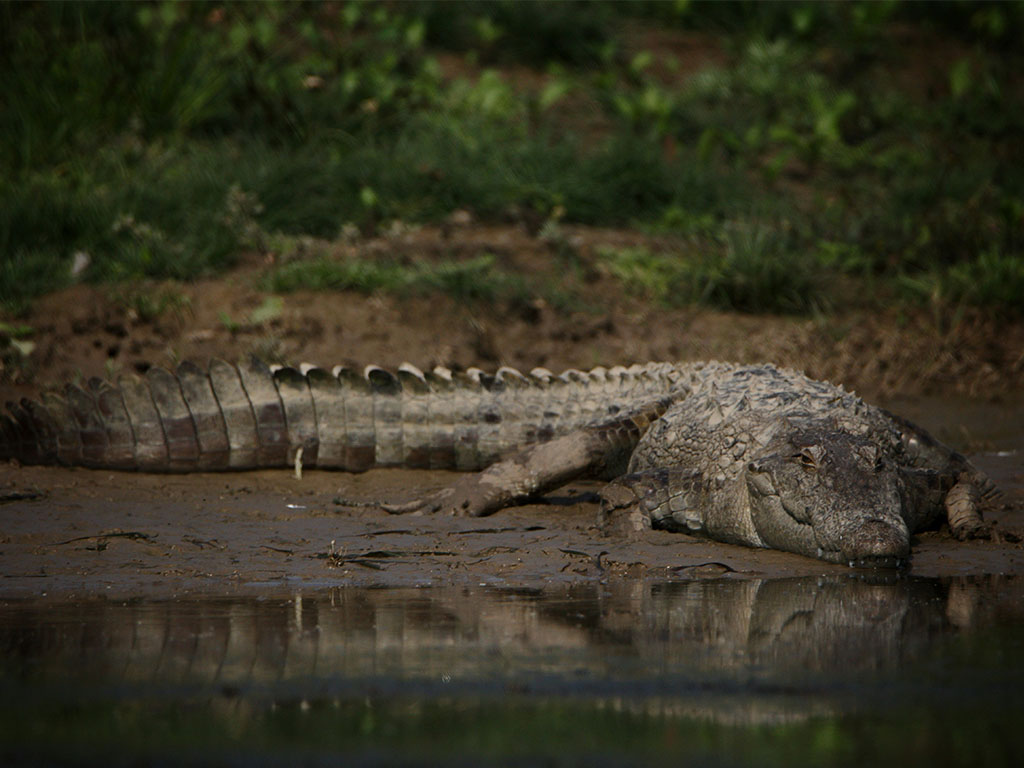
Three hours, maybe four, depending on the park. You will see — across the week — many things that are not the headline animal. Sambar grazing in soft light. A jungle cat crossing the road. A crocodile at the lake. A treepie following the vehicle for the few seconds you have your sandwich. These are the days that make a good week.

Back at the property by mid-morning. A long brunch — eggs cooked to your taste, fruit, fresh juices, parathas, whatever the kitchen feels like making.
The middle of the day is yours. The forest is closed to vehicles between roughly eleven and three — animals rest, and so do most travellers. A swim. A nap. A book. The reading list your naturalist puts out by the pool. Some travellers walk the property grounds for birds. Some sit and watch the kitchen smoke rise. The pace is deliberate.
Lunch around two — usually outdoors, often whatever the gardeners brought back that morning. By three, the light is changing. Time to think about the afternoon drive.
Out again as the heat begins to break. Different zone, different naturalist intelligence — your guide has spoken to the morning team and knows where activity is concentrating.
Afternoon drives have a different character. The light is lower, more golden. Animals begin to move. Cats wake from their day in the rocks. The forest slowly comes back to its evening rhythm. Sometimes the afternoon is when the photographs get made.
By six, the sun is low and the gate closes. You return to the property with the last of the light, often through villages, sometimes past a leopard on a wall or a hyena at the edge of a field.
A drink before dinner — beside a fire if the night is cold, on the lawn if it is mild. Most properties bring out a single course at a time, slowly. There is no rush.
Your naturalist often joins for an hour, with stories from the day or the year. They have done this for long enough that the stories are good. Sometimes a guest from another property drifts over. Sometimes a hyena calls from the edge of the camp, and everyone listens.
By ten, most travellers are asleep. The day starts again at four-forty-five.
Earth tones — browns, olives, greys. Layers for cold mornings and warm afternoons. Closed shoes for walks. A wide-brimmed hat. Sunglasses you can tolerate dust on.
Binoculars (8×42 is the standard). A camera if you have one. Sunscreen. A small daypack. A reusable water bottle — we provide refills throughout.
Not very. Drives are seated. Walks are gentle in Kumbhalgarh, optional elsewhere. The early starts are the main physical demand.
Welcome, with caveats. Generally we suggest age 8+, depending on the destination and the property. Speak to a journey designer.
Standard travel insurance is required. Most properties have on-call doctors. Mobile reception is good in towns, intermittent in the parks.
Wi-Fi at every property — usually decent. Inside the parks, no signal. We consider this a feature, not a bug.
Tea at 5:00–5:15am for most parks. Out by 5:45. Inside the gate as it opens at first light. The early start is non-negotiable for tigers and leopards — they are at their most active in the first hour of daylight.
Yes. Shared vehicles introduce other travellers' priorities into your sighting — somebody wants to leave, somebody wants to wait, somebody is on a phone. A private vehicle means your naturalist sets the pace, and the silence around a sighting is yours.
It happens, occasionally. We work hard to make it unlikely — multi-day stays, multiple zones, senior naturalists. But the wild does what it does. Travellers who arrive with the right expectations — that the journey is the point, not just the headline animal — almost always come away with more than they expected, even on the rare drive without a sighting.
Mostly. Speak softly. No music. No phones playing audio. Movement also matters — sudden gestures spook animals more than voices. Your naturalist will guide you when to move and when to be still.
Two a day is the standard, and the right number for most travellers. Three a day in some parks is possible but rarely additive — you start to fade by the third. We'd rather you be sharp on two drives than tired across three.
Tell us when you'd like to travel, how long, and what you're drawn to. A journey designer will respond within 24 hours.